

If you run a shop, a trade business, or a local service company, you have probably asked this more than once: how often should I be posting? Post every day and it takes over the evening. Post once in a while and the page goes quiet just when a customer might be looking.
There is no single number that works for every business. There are, however, solid starting points, and a way to find a cadence you can actually keep. This article walks through both, using published research — not guesswork — and then shows how to adjust from there.

Consistency matters more than a high count
Sprout Social’s 2026 guide for small businesses puts it plainly: consistency is more important than frequency. For most small businesses, posting 3 to 5 times per week on each platform you actively use is a sustainable goal that keeps the brand visible without overwhelming a small team (“Social Media Marketing for Small Business: Complete Guide for 2026,” Sprout Social).
That matches what many owners already feel. A schedule you can keep for three months will do more than a burst of daily posts that stops after two weeks. Customers notice that you are still there, not that you hit a perfect volume.
Sprout’s broader 2025 research, based on nearly 3 billion messages from 1 million public profiles, found that the industry average had fallen to 9.5 posts per day across all platforms combined — not per channel — down from 11 per day in 2022 (Jasmine Williams, “How often to post on social media,” Sprout Social, Aug. 27, 2025). Brands, in other words, have been posting a little less and putting more weight on quality. That average includes large teams. It is not a target for a local business posting in-house.
Starting points by platform
Hootsuite’s 2025 review of posting frequency, which combined expert practice with how real businesses post, offers these recommended minimums (Hannah Macready, “How often should a business post on social media? [2025 data],” Hootsuite, April 18, 2025):
Instagram: 3 to 5 times per week (Stories: 2 times per day)
TikTok: 3 to 5 times per week
Facebook: 1 to 2 times per day
X: 2 to 3 times per day
LinkedIn: 1 to 2 times per day
Google Business Profile: at least once per week
Pinterest: at least once per week
Treat these as a ceiling you can work toward, not a quota you have to hit next week. Hootsuite’s own social media manager, Trish Riswick, makes the point directly: if your team cannot post once a day on every network, aim for every other day. “Three quality posts are worth more than five low-quality posts.”
Hootsuite also found, on Instagram specifically, that two good posts a week can earn more overall engagement than 20 mediocre ones, and that 6 to 7 strong posts per week sat at a “sweet spot” in their data. If you cannot get to 6, start with 3 solid posts and stay there until it is easy.
Facebook’s recommended range (1 to 2 posts a day) is higher than most small teams can sustain well. Hootsuite notes that even two great posts a week can still produce solid engagement on Facebook. For a local business, a few excellent posts plus a Story or two will usually beat a daily filler post.
A practical weekly cadence for a small team
If you are doing this yourself, pick the two platforms your customers actually use — for many local businesses, that is Facebook and Instagram, sometimes with Google Business Profile — and ignore the rest until the first two feel routine.
A realistic starting week:
3 posts that would still be useful a month from now: a finished job or product, a short how-to, a seasonal reminder, or an answer to a question you hear in person
1 or 2 Stories (or a short Reel) that show the work as it happens
1 Google Business Profile update in the week, even a simple photo and a sentence about hours, a service, or a recent project
That is already close to Sprout’s 3-to-5-times-a-week baseline on the channels that matter, without asking you to post 1–2 times a day on Facebook and LinkedIn. You can add volume later if the work is getting seen and you still have something worth saying.
If you already know that your customers spend time on TikTok, add 3 short videos a week only after the first two platforms are steady. New channels are easier to add than to keep alive when the main pages start slipping.
What to post so the schedule does not go stale
Frequency only helps if the posts are useful. A simple mix keeps you from repeating the same offer every time:
Proof of work: finished jobs, before-and-after photos, or a product that just went out the door
Answers: the questions your customers ask on the phone
Practical tips that are specific to your trade or your town
A little of the person behind the business, without making every post about you
Clear invitations to call, book, or visit when it is genuinely useful
You do not need a new idea every day. You need a short list you can rotate. If you want help with the graphics and captions themselves, our content creation is built into every plan, and our free social post toolkit is there if you are still posting on your own.
Frequency and timing are different questions
How often you post is not the same as when you post. Once you have a weekly count you can keep, place those posts at times your audience is actually online. We built a free Best Time to Post planner for that: you pick the platforms and how often you can post, and it returns a one-page weekly plan based on published engagement data. No email or sign-up is required.
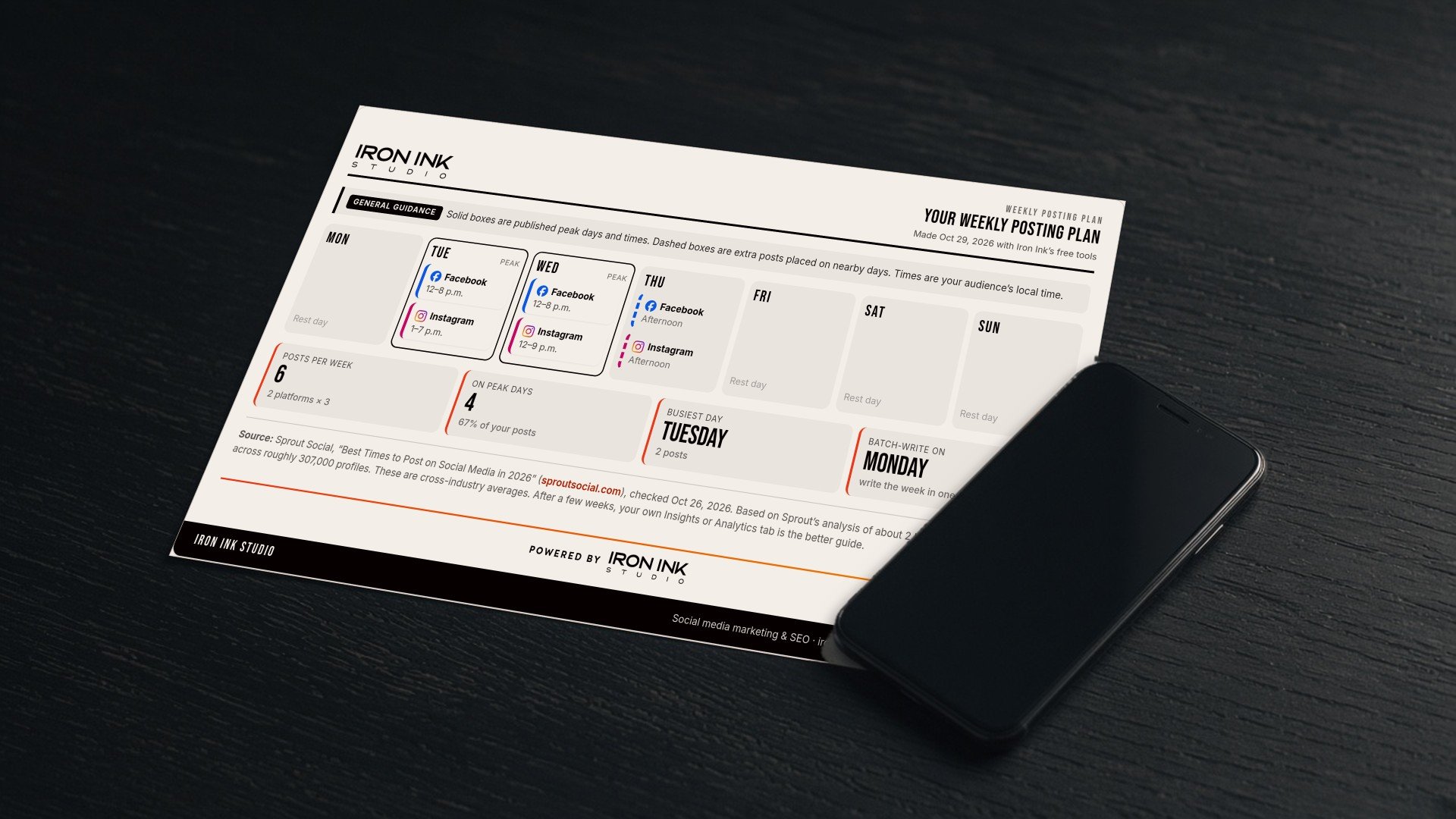
After a few weeks, your own Insights or Analytics tab is a better guide than any industry average. If a Tuesday morning post is consistently seen and a Friday evening post is not, move the Friday slot.
How to know if your cadence is working
Give a new schedule at least four weeks before you overhaul it. During that stretch, look at:
Reach or impressions: are more of the right people seeing the posts?
Engagement: comments, saves, shares, and replies, not just likes
Profile visits and link or call-button taps
Whether you actually kept the schedule
If you kept the cadence and nothing moved, change the content or the times before you simply post more. If you could not keep the cadence, it was too ambitious — cut the count, not the quality.
When it makes sense to hand it off
Some owners enjoy the posting and just needed a realistic number. Others know the pages should be active and also know the work will not get done after a full day on the job. That is the gap social media management is meant to fill.
Iron Ink Studio plans, writes, designs, and posts for small businesses. You can see how it works in three steps: pick a plan, connect your pages, and we post for you. Plans start at $49 a month for 3 posts a week on one platform you pick, which matches the sustainable baseline in the research above. The Local plan is $99 a month for 5 posts a week on three platforms (Facebook, Instagram, and Google Business Profile by default). The All-In plan is $249 a month for daily posting on Facebook, Instagram, TikTok, X, and Google. There is no contract, and extra platforms can be added for $10 a month each.
If you want us to take it off your plate, book a time or email us at info@ironinkstudio.com. If you want to keep posting yourself, start with 3 good posts a week on the platforms you already use, print a plan from the Best Time to Post planner, and adjust from your own results. The right frequency is the one you can keep — and that your customers still want to see.
